01
You approve what it learns
New capabilities never switch themselves on. They arrive as proposals with a description you can read, and become active only when you approve them — rejecting one takes a single command.
Governed memory · by Consultancy in Action
Out of the box, an assistant forgets everything between sessions. Self-Improve gives it a governed memory: it reviews each session, proposes what to remember, and only learns what you approve — every write journaled, one file pausing the whole loop. Local-first, £0 to run.
A governed memory & learning loop for AI assistants, at a glance
Consent-first
You approve what it learns
New skills arrive as proposals with a description you can read. Nothing self-activates.
£0 to run
On the subscription you have
Plain files, no database, no API keys, no cloud service. Local-first by construction.
Any agent
One loop, swap the storage
Claude Code, AEGIS, Codex, Hermes, or a local model — the methodology is agent-neutral.
Why it exists
Out of the box, an assistant forgets everything between sessions. You repeat the same corrections, restate the same preferences, re-teach the same techniques — and every repeated correction is paid for twice: once in time, once in trust.
The obvious fix — let the assistant rewrite its own instructions — is also the obvious governance nightmare. Unsupervised self-modification is exactly the failure mode responsible AI operations exist to prevent.
The real problem isn't making an assistant learn — models do that eagerly. It's making one learn safely: never the wrong lesson, never a silent rewrite, and always under a human who can see it, veto it, and stop it.
How the loop works
Two kinds of learning, kept separate: memory (who you are, the state of the world) and skills (how to do a class of task). Every step is journaled.
01
At the end of a session — or on demand — the loop reads the conversation against a written methodology, looking for three signals: you corrected the assistant, a non-trivial technique emerged, or an existing instruction proved wrong.
02
Findings become drafts. Corrections and preferences become memory (who you are, the state of the world); reusable techniques become skills (how to do a class of task). Named for the class of task, never today's specific bug — and nothing goes live.
03
In consent-first mode a new skill is a proposal you approve or reject with a single command. Approve promotes it into the live library; reject archives it, dated. One file pauses the entire loop instantly.
04
A weekly pass merges overlapping learned skills and archives stale ones, so the library stays sharp instead of silting up. Its AI pass has no shell — it only proposes moves a validating script checks before applying. Every move is journaled.
The full command surface — review, approve, reject,
curate, pause — lives on the commands page →
The governance is the product
"AI that improves itself" is usually a demo or a liability. This is the third thing — a learning system a business could actually operate, because every way it could go wrong is gated.
01
New capabilities never switch themselves on. They arrive as proposals with a description you can read, and become active only when you approve them — rejecting one takes a single command.
02
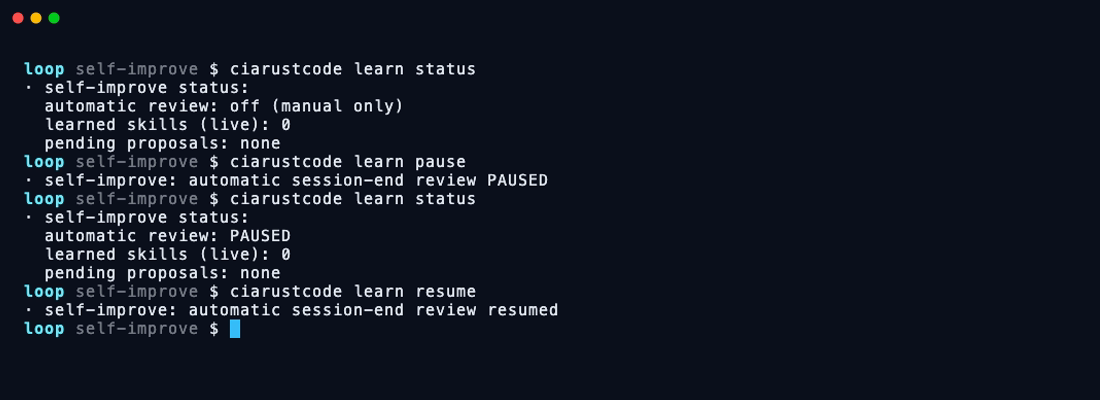
A pause flag kills every automatic review and curation instantly, no uninstall required. Manual use keeps working; the automation simply stands down until you say otherwise.
03
The background reviewer gets read-only tools plus write access to exactly two areas — memory and proposals — under a 15-minute hard cap. It cannot edit your files, settings, or any skill: every skill change is a proposal you approve. That's enforced by its tool permissions, not just policy.
04
Every learned skill carries provenance in the file itself. Anything without that stamp — your own skills, bundled ones, a protected list — is invisible to the loop and the curator alike.
05
Archive is the maximum destructive action: rejected proposals and retired skills are moved, dated and kept. The journal records every action — including the sessions where it chose to save nothing.
By the numbers
3
build phases shipped
manual review → gated auto-review hooks → weekly curator
7
commands in the loop
review · status · approve · reject · curate · log · pause/resume
2 areas
reviewer's write scope
headless, read-only tools; writes limited to memory + proposals under a 15-min cap — skill changes are proposals you approve, never live edits
100%
of writes journaled
append-only journal; archive-only — nothing is ever deleted
£0
marginal cost to run
plain files + the subscription you already pay for — no DB, no keys, no cloud
4+
agents it runs on
Claude Code, AEGIS, Codex, Hermes, or a local model — one methodology, swap the storage
We'll be honest about its age: on our own Claude Code deployment the journal is a handful of entries deep, one learned skill is live so far, and the automation is currently paused — by choice, with the one-file kill switch. That's the control working exactly as designed.
How it was built
Phase 1
A single command reviews the session against a written methodology and writes memory + skill proposals. Updating-in-place beats duplicating; a do-not-capture list keeps transient failures out; in consent-first mode a new skill never goes live. Every action — including “nothing to save” — is appended to a tamper-evident audit journal.
Phase 2
Session-end hooks call a gatekeeper that only fires a review when thresholds are met — enough user turns, tool calls, or repeated correction signals — under a daily cap, a per-session gap and a single-review lock. The reviewer sees a redacted digest and runs headless with tools cut to read-only plus two writable folders, under a 15-minute cap.
Phase 3
A weekly curator merges overlapping skills and archives stale ones. Its AI pass has no shell at all — it only proposes moves in a plan file; a validating script checks provenance, pins and protection rules before applying anything, then commits the library to git. Nothing is ever deleted; skills the loop didn't author are untouchable.
“AI that improves itself” is usually either a demo or a liability. This is the third thing — a learning system a business could actually operate, auditable end to end, running at £0 marginal cost on the subscription already paid for.
| Route | Typical cost | Time to ship |
|---|---|---|
| Specialist AI-platform consultancy | £40k–£80k | 2–4 months |
| Consultancy in Action — AI-accelerated | A fraction · £0 to run | 3 days, 3 phases |
The command surface
Type /self-improve mid-session, or drive it from a script with learn review / approve / curate / pause. Consent-first, journaled, pausable.
See the commands →
Take it to any agent
The loop is agent-neutral markdown — only the storage paths differ. Adapter table for Claude Code, AEGIS, Codex and more, plus a one-paste pocket version.
How it travels →
Private preview
Self-Improve is in private preview while we harden it on our own work. Leave an email for early access — or talk to Consultancy in Action about wiring governed memory into your assistant or agent fleet.